Ducking + Sidechain
One kick lane and one snare lane fan out across the entire bus tree. Five duckers, not fifty. Asymmetric ducks per family. Cleared room for the framework to land.
The Premise
Loud mixes are not about turning everything up. They are about making room at the moments where the loudest things happen. The kick and snare are the framework anchors at or near 0 dBFS. Every other family must briefly step out of the way so the kick and snare can fully extend without summing into clipper-crushing peaks.
Sidechain ducking is how you carve that room without touching faders. A short volume dip triggered by the kick and snare on every other bus. Done at the bus level, not per loop. Tuned per family so each one yields exactly as much as it should.
"Many small clips beats one big clip. Many small ducks beats one big duck. The whole CTZ method is distributed work."
The Diagram
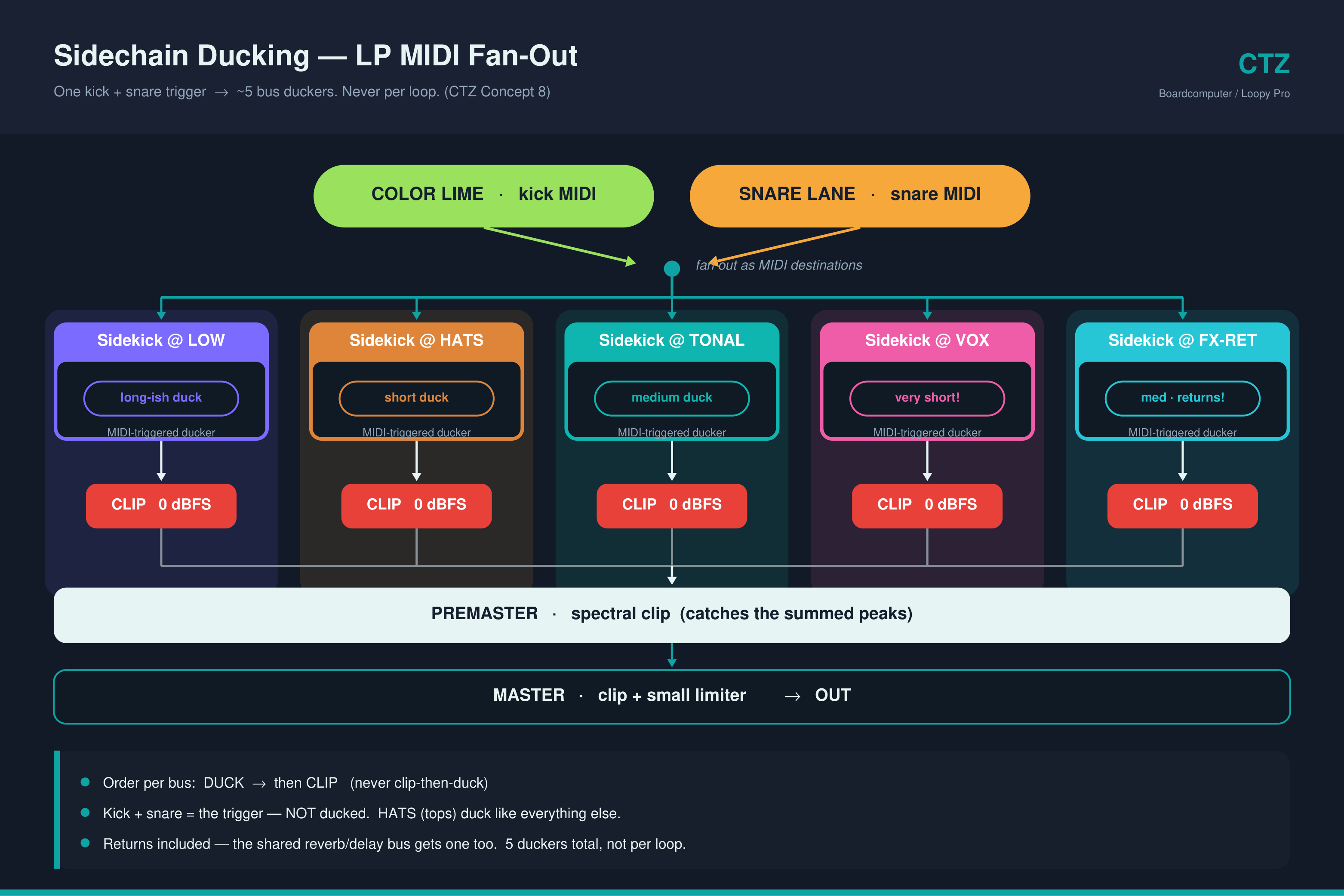
What Gets Ducked, By How Much
The kick and snare are the trigger, never ducked. Everything else yields. The amount each family yields is what makes the mix breathe rather than pump.
| Bus | Duck length | Curve / notes |
|---|---|---|
| Sidekick @ LOW (subs) | Long-ish duck | Genre-dependent. Loud EDM = eighth-note on the kick. Sub harmonics mask the pump. |
| Sidekick @ HATS (tops) | Short duck | Cymbals duck too. Short enough to keep the shimmer, long enough to clear summing. |
| Sidekick @ TONAL (midline) | Medium duck | Covers chords, leads, plucks, drops, lifters, atmos at one bus. Custom curve per arrangement. |
| Sidekick @ VOX | Very short! | Transient-only. Longer ducks chop syllables. Avoid the click, not the word. |
| Sidekick @ FX-RET | Medium, returns! | The shared reverb/delay return bus gets a ducker too. Keeps tails out of the framework window. |
Kick + snare = the trigger, NOT ducked. HATS (tops) duck like everything else. Do not exempt cymbals.
Why the Asymmetry
Five different durations, five different curves. Not laziness, not preference. Each family has different perceptual stakes:
LOW gets a long-ish duck
Subs and kick share the bottom octave. A long duck stops phase-rubbing buildup in the kick window and stops the combined low energy from spiking the bus clipper. Sub harmonics above ~120 Hz mask the pump so it sounds continuous, not punched.
HATS gets a short duck
Tops own 6 kHz+ and need to feel uninterrupted. A short duck clears the snare transient summing point without killing the cymbal pattern. Long duck here = drum-machine pumping artifact.
TONAL gets a medium duck
This is the biggest energy block on the mix - chords, leads, drops, lifters, atmospheres. Medium duck with a smooth crossfade carves room for the framework without making the music feel absent during kicks.
VOX gets a very short duck
Vocals carry words. Any audible duck on a syllable shows up as a chop. The only thing you are ducking here is the click summing point. Set it just long enough to keep the vocal off the kick transient, not the kick itself.
FX-RET gets a medium duck with returns enabled
The shared reverb/delay return bus is where every long tail lives. If reverb tails bloom across the kick window, they sum against the kick transient and force the bus clipper to work harder than it should. One ducker on the return bus, sidechained from the same kick + snare lanes, keeps tails out of the framework. Easy to forget. Always include it.
Where the Ducker Sits in the Chain
The order per bus is non-negotiable.
Source loops
   |
   v
[BUS]  DUCK  ->  CLIP @ 0 dBFS
   |
   v
Premaster (spectral clip catches summed peaks)
   |
   v
Master (clip + small limiter) -> OUT
Duck first, then clip. Never clip-then-duck. Clipping after ducking means the clipper only has to handle the post-duck peaks. Clipping before ducking means the clipper does the loud work first, then the ducker pulls down already-distorted audio - you get the worst of both.
Per bus: DUCK then CLIP. Never clip-then-duck. Holds at every bus level - sub-bus, parent bus, premaster.
Spectral Ducking on the Midline
Broadband duckers work for subs, tops, returns. For the midline bus sidechained against the vocal bus, a broadband duck eats too much music to clear room for a voice that only occupies a narrow band at that moment.
Switch to a spectral ducker here. Sonible Smart:Comp spectral mode or Wavesfactory Trackspacer. The ducker only pulls down the frequencies where vocal energy exists at that instant. The rest of the midline plays through untouched. Result: a vocal that sits forward without a hole punched through the music behind it.
| Ducker type | Where | Why |
|---|---|---|
| Broadband sidechain | LOW, HATS, TONAL (vs kick+snare), FX-RET, VOX | Cheap, fast, controllable curve. Default everywhere except midline-vs-vox. |
| Spectral ducker | Midline bus sidechained from vocal bus | Pushes down only the frequencies a vocal occupies right now. Transparent. |
The MIDI Fan-Out in Loopy Pro
Hosts like Ableton have ganged sidechain inputs as a first-class concept. Loopy Pro does not. The CTZ ducking pattern is implemented as MIDI:
- Color lime a kick lane. Its MIDI is the kick trigger.
- Snare lane = the snare trigger MIDI.
- Both lanes fan out as MIDI destinations to the five ducker plugins on each bus.
- Each ducker is a MIDI-triggered envelope follower (or VCA envelope on incoming MIDI), set to its bus-specific duration and curve.
- The ducker pulls down its bus channel only. Bus then hits its clipper @ 0 dBFS.
Five duckers total. Not one per loop. Not one per channel. Five. The kick + snare lanes are the only triggers; the buses are the only targets.
What Stays Off the Ducker
- Kick + snare themselves. They are the trigger, not a target. Ducking them defeats the framework.
- Premaster bus. Premaster catches summed peaks via spectral clip. Ducking here would chase its own tail.
- Master bus. Master is dynamics only - clip + small limiter. No ducking.
- Individual loops. If you find yourself adding a per-loop ducker you have moved off the method. Pull back, group into the right bus, put the ducker on the bus.
Tuning the Curves
Duration and curve are genre-dependent. Loud EDM tolerates aggressive ducks - up to eighth-notes on the kick. A quieter, more dynamic mix wants transient-only ducks that nobody can identify by ear but the clipper feels.
| Parameter | Guidance |
|---|---|
| Kick duck length | Typically longer than the snare duck. Eighth-note on hard EDM, transient-only on dynamic material. |
| Snare duck length | Typically shorter than kick. Snare is sharper and shorter, the duck matches. |
| Curve shape | Custom per bus. Smooth crossfade, no audible pumping - unless pumping is the genre. |
| Per-trigger separation | Set kick and snare ducks independently on each bus. Same plugin, two envelopes. |
Why This Saves the Clipper
Ducking is upstream work. Done right, the bus clipper that sits after it almost never has to flatten serious peaks - because the ducker already pulled the floor down for the loudest moments.
The whole CTZ philosophy: distribute the loudness work across the cascade. Saturate the body upstream. Duck the framework window. Clip small amounts at every bus. Spectral clip the premaster sum. Clip + small limiter the master. No single stage does too much. The mix gets loud because every stage did its share, transparently.
"If a bus sounds over-clipped, you know exactly which bus to dig into. If you only clip at the master, you have nowhere to look."